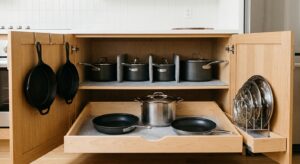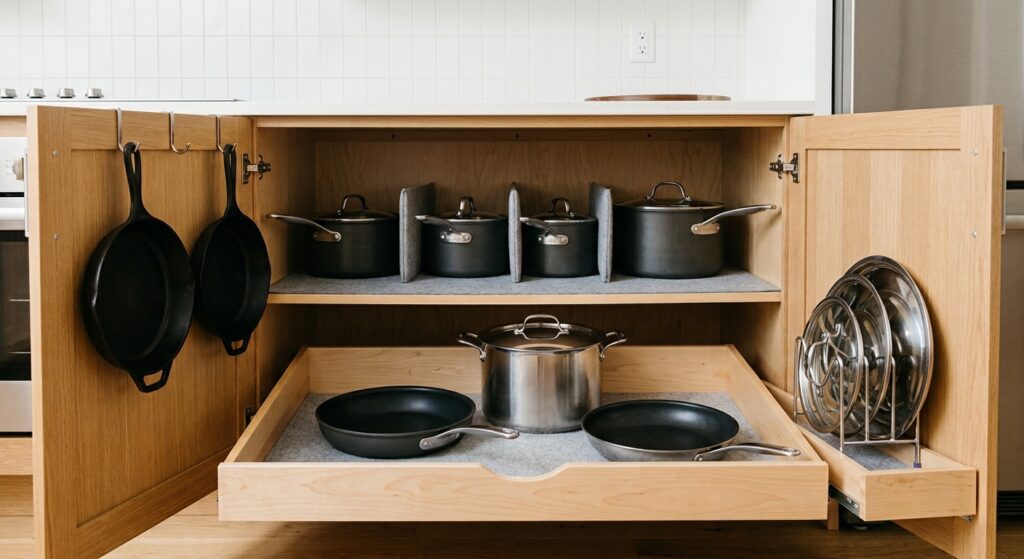
Vertical dividers, hanging storage, and separate lid racks all help protect cookware while saving space.
This post contains affiliate links — as an Amazon Associate, we earn from qualifying purchases.
Most guides on how to organize pots and pans come from cabinet companies and home organization bloggers, and they’ll happily tell you to stack everything neatly and call it a day. What they usually miss is that how you stack Cookware can quietly wreck it. Nonstick and ceramic coatings scratch against bare metal, cast iron seasoning wears down faster than you’d expect, and a “neat” cabinet can still be slowly damaging the pans inside it.
How to Organize Pots and Pans by Material
Nonstick and ceramic-coated pans: Never stack these directly on top of each other. The coating scratches easily against another pan’s metal rim or base. Use felt or fabric pan protectors between each piece, or store them on their sides in a vertical rack so nothing rests on the coated surface.
Cast iron: Stacking is generally fine since the material is far more durable, but a thin cloth or paper towel between pieces still helps preserve the seasoning by preventing bare metal from scraping across the cooking surface.
Stainless steel: The most forgiving material to stack, since it doesn’t have a coating to damage. Lids are the bigger concern here; nested lids can scratch each other’s glass if stacked carelessly.
👉 Browse pan protectors for nonstick and ceramic cookware
Storage Solutions Worth Considering
Vertical dividers. Adjustable dividers inside a drawer or cabinet let pans stand upright rather than stack, which is the single best way to protect coated cookware while also making everything easier to grab without digging.
A hanging pot rack. If cabinet space is tight, hanging pots overhead frees up storage entirely, though it works best for stainless steel and cast iron rather than delicate nonstick, since hanging pieces can knock against each other.
nesting cookware sets. If you’re setting up a kitchen from scratch and storage space is the real constraint, our nesting cookware set guide covers sets specifically designed to stack compactly without the scratching risk of stacking mismatched pans.
👉 Browse cabinet organizers for pots and pans
What to Avoid
Piling pans directly on top of each other with no barrier. This is the single most common mistake, and it’s the fastest way to scratch through a nonstick or ceramic coating well before it should wear out.
Storing lids stacked flat on top of pots. Beyond taking up awkward space, this often means the lid slides or the handle knocks against the pot’s rim repeatedly over time.
Cramming a cabinet so full that pans need to be forced in or out. Beyond the noise, this is how handles get bent and coatings get scraped during the daily process of retrieval.
If You’re Starting From Scratch
If you’re building out a new kitchen and want cookware that’s genuinely easier to store well, it’s worth thinking about storage before you buy rather than after. Our pots and pans set buying guide covers material and construction choices that hold up better to the realities of cabinet storage, not just performance at the stove.
Frequently Asked Questions
Can you stack nonstick pans on top of each other? It’s not recommended without a protective layer between them, since bare metal rims and bases can scratch through nonstick and ceramic coatings over time.
What’s the best way to organize pots and pans in a small kitchen? Vertical dividers or a nesting cookware set both save meaningful cabinet space compared to traditional stacking, without requiring extra storage furniture.
Do lids need special storage? Ideally yes. Storing lids upright and separately from pots, rather than stacked flat on top, prevents scratching and makes it easier to find a matching lid quickly.
Is it bad to hang cast iron pans? No, cast iron handles hanging storage well due to its durability, though it’s worth ensuring hung pans have enough space between them to avoid knocking together repeatedly.
For broader cabinet layout ideas beyond just cookware, The Container Store’s kitchen organization guide is a solid independent resource for planning storage systems.
Disclosure: This post may contain affiliate links. If you make a purchase through one of our links, we may earn a small commission at no extra cost to you.