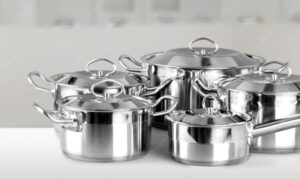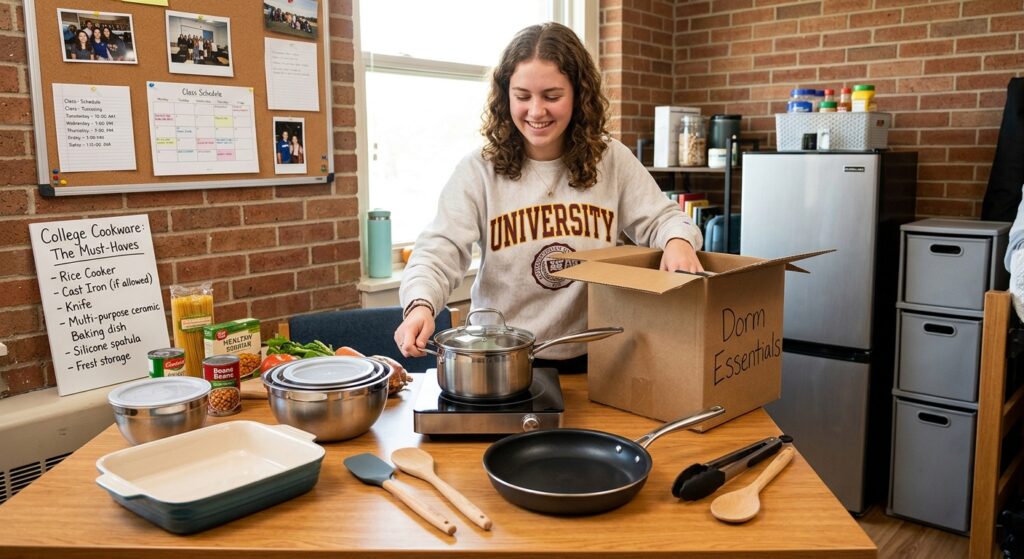
A few well-chosen pieces cover most dorm cooking needs without crowding a shared space.
This post contains affiliate links — as an Amazon Associate, we earn from qualifying purchases.
Most guides on the best Cookware for college dorms jump straight to product picks without asking the one question that actually determines what you’re allowed to buy: what does your dorm’s housing policy say about cooking? Skip that step and you might buy a beautiful cookware set that’s completely useless in a room where open flames and hot plates are banned outright.
Check Your Dorm’s Rules Before You Buy Anything
Dorm cooking rules vary wildly, and they’re not always intuitive. Some dorms allow a small portable induction burner but ban anything with an open flame. Others restrict cooking to microwaves and electric kettles only, no stovetop appliances at all. A few, usually in apartment-style dorms or upperclassman housing, allow a full kitchenette setup. Before spending a dollar on cookware, check your specific housing policy, since the answer changes everything about what’s actually worth buying.
If You Have a Portable Induction Burner or Stovetop
A small nesting cookware set is the smartest buy. It covers a frying pan, a saucepan, and a small stockpot while taking up a fraction of the storage space a traditional set demands, which matters enormously in a room with one shared closet. Our nesting cookware set guide covers what to look for if you’re shopping this category specifically.
👉 Browse nesting cookware sets for dorms
Confirm induction compatibility if that’s your setup. Not every stainless steel pan works on induction, and portable induction burners are the most common dorm-legal cooking option, so this is worth double-checking before buying rather than after.
If You Only Have a Microwave
Skip traditional cookware entirely and look at microwave-safe cookware instead, things like a microwave pasta cooker or a collapsible silicone bowl set. This is a genuinely different shopping category than stovetop cookware, and most general Cookware Guides don’t cover it at all because it isn’t “cookware” in the traditional sense.
👉 Browse microwave-safe cooking sets for dorms
What Material Actually Makes Sense Here
Nonstick or ceramic-coated. Easiest cleanup for a shared sink situation, and forgiving for anyone still learning to cook. The tradeoff is a shorter lifespan than stainless, which is a fair trade for four years of dorm use.
Stainless steel. More durable and harder to damage through rough shared use, but it takes more technique to avoid sticking, which can be frustrating for a first-time cook.
Skip cast iron. It’s heavy, needs maintenance most students won’t keep up with, and it’s genuinely impractical to move at the end of every semester.
What to Skip Buying
A large multi-piece set. Most students use two or three pieces regularly and let the rest sit unused, taking up space that’s already at a premium. If budget is the main driver, our guide to cookware sets under $100 covers smaller, smarter sets that don’t waste money on pieces you won’t touch.
Anything that isn’t dishwasher-safe, if you have access to one. Shared kitchens rarely leave time for careful hand-washing between classes.
Cookware you’re not prepared to move four times a year. Between move-in, winter break, summer storage, and move-out, dorm cookware gets packed and unpacked constantly. Lightweight, stackable pieces hold up to that far better than anything heavy or fragile.
Frequently Asked Questions
Can I use regular cookware in a dorm? Only if your dorm allows stovetop cooking or a portable induction burner. Many dorms restrict cooking to microwaves only, so checking your specific housing policy first is essential.
What’s the best cookware set size for a dorm? A compact 3-5 piece set covers most dorm cooking needs. Larger sets usually just take up storage space without adding real value for a single student.
Is nonstick or stainless steel better for a dorm? Nonstick is generally easier for a beginner cook and easier to clean in a shared kitchen, while stainless steel holds up better to rough, frequent use over four years.
Can I bring cast iron to college? Technically yes, but its weight and maintenance needs make it impractical for most dorm situations, especially with cooking bans on many stovetop appliances.
Housing rules vary by school, so it’s worth checking your own institution’s policy directly — many universities publish these guidelines online, such as Cornell’s residential hall cooking policy, which is a good example of how detailed these rules can get.
Disclosure: This post may contain affiliate links. If you make a purchase through one of our links, we may earn a small commission at no extra cost to you. </content>