This post contains affiliate links — as an Amazon Associate, we earn from qualifying purchases.
The most common mistake buyers make shopping for the best Cookware for induction cooktops is assuming “stainless steel” is enough. It isn’t. induction cooking works through magnetism, not direct heat contact, which means a pan can be full stainless steel and still sit dead on an induction burner if its base isn’t magnetic. Before you buy anything, the material matters less than one specific test.
What Makes Cookware Work on an Induction Cooktop
Induction cooktops generate heat by creating a magnetic field that reacts with the cookware’s base — no magnetic reaction, no heat, regardless of how good the pan is otherwise. This is different from gas or standard electric coils, which heat the cookware through direct contact and work with almost any material. It’s why cookware that performs beautifully on every other stove can be completely useless on induction.
The 10-Second Test Before You Buy Anything
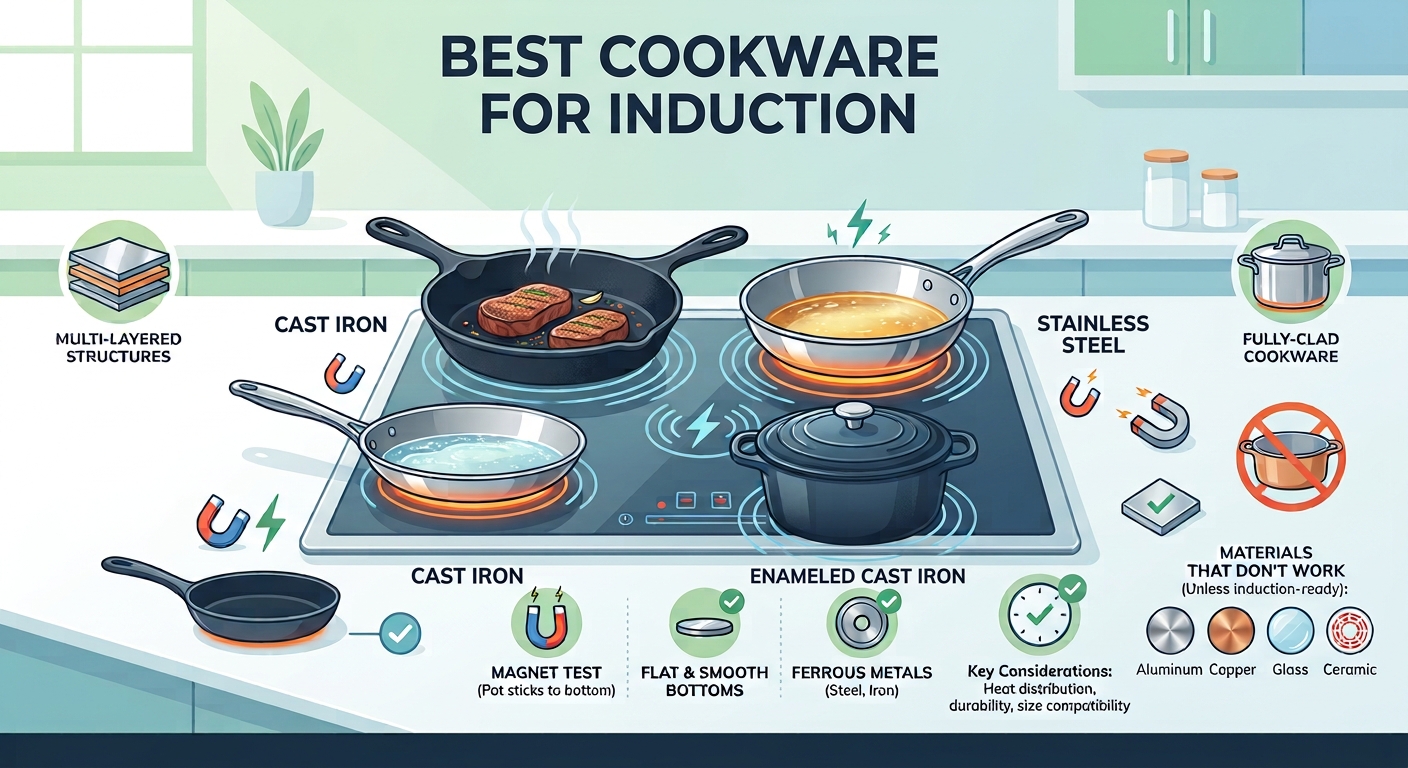
Hold a refrigerator magnet to the bottom of the pan. If it grips firmly, the pan will work on induction. If it doesn’t stick at all, or only weakly, skip it — no amount of good reviews changes that. This test works on cookware you already own just as well as it works in a store, and it’s more reliable than trusting a listing’s “induction compatible” label, which sellers occasionally get wrong.
What Actually Works
Magnetic stainless steel. The most common induction-compatible material, and the safest default if you’re building a full set. Confirm magnetic grade specifically — some higher-end stainless (like 18/10, prized for its shine and corrosion resistance) is actually non-magnetic and won’t work.
👉 Browse induction-compatible stainless steel cookware
Cast iron, bare or enameled. Naturally magnetic and one of the most reliable induction performers available, though its weight and heat retention are worth factoring in separately from compatibility.
👉 Browse cast iron cookware for induction
Carbon steel. Less common in home kitchens but fully induction-compatible, and a strong pick if you want something lighter than cast iron with similar magnetic properties.
Nonstick or ceramic-coated cookware with a magnetic base. The coating itself has nothing to do with induction compatibility — what matters is the metal underneath. Many nonstick sets are built on an induction-ready stainless or aluminum-and-steel base specifically to cover this.
What Doesn’t Work
Pure aluminum or copper, uncoated. Both are excellent heat conductors but neither is magnetic, so neither will trigger an induction cooktop on their own. Copper-core cookware only works on induction if it has a magnetic stainless steel layer on the outside — check the base, not the marketing.
Glass or ceramic cookware. Common for baking dishes and some specialty pieces, but not induction-compatible in any form.
Some “premium” non-magnetic stainless steel. Counterintuitively, higher grades of stainless steel prized for polish and corrosion resistance can be non-magnetic. Don’t assume “stainless steel” alone is enough — always run the magnet test.
Induction Cookware by Budget
Under $50: A single magnetic stainless steel skillet or a basic cast iron pan — both reliably induction-safe without paying a premium for the label.
$50–$120: A compact induction-ready set, similar to what’s covered in our cookware under $100 guide, or a mid-size enameled cast iron piece.
$120 and up: Fully-clad tri-ply or 5-ply stainless steel, which is induction-compatible by design and offers the most even heat performance on an induction surface specifically. Our tri-ply vs. 5-ply breakdown explains why the extra layers matter more on induction than on gas.
A Few Things Worth Knowing Before You Buy
Flat, smooth bases perform best. Induction cooktops are almost always a glass or ceramic surface, so the same rules that apply to cookware for glass-top stoves apply here too — a warped or rough base won’t just cook unevenly, it can scratch the surface.
Pan size should roughly match the burner’s induction zone. Induction cooktops sense the base and heat only the area the pan covers, so a pan noticeably smaller than the burner’s coil wastes efficiency and may not heat evenly.
Small kitchens benefit doubly here. If you’re also tight on storage, a nesting cookware set with a magnetic base gets you induction compatibility and space savings in one purchase rather than two separate trade-offs.
Frequently Asked Questions
How do I know if my cookware works on induction? Hold a magnet to the bottom of the pan. If it grips firmly, the pan is induction-compatible. If it doesn’t stick, the pan won’t heat on an induction cooktop regardless of what material it’s made from otherwise.
Does all stainless steel work on induction? No. Only magnetic-grade stainless steel works on induction. Some premium stainless steel, prized for its shine and corrosion resistance, is non-magnetic and won’t trigger an induction cooktop at all.
Can I use regular nonstick pans on induction? Only if the base underneath the coating is magnetic. The nonstick coating itself has no bearing on induction compatibility — check the base material, not the coating.
Is cast iron good for induction cooktops? Yes, cast iron is naturally magnetic and one of the most reliable materials for induction cooking, whether bare or enameled.
Why won’t my aluminum or copper pan heat up on my new cooktop? Neither aluminum nor copper is magnetic on its own, so neither will generate heat on an induction cooktop unless it’s bonded to a magnetic stainless steel base.
If you’re deciding whether to switch to induction cooking in the first place, the U.S. Department of Energy’s guide to induction stoves and cooktops is a straightforward, non-commercial overview of how the technology works and what to expect.
Disclosure: This post may contain affiliate links. If you make a purchase through one of our links, we may earn a small commission at no extra cost to you.