This post contains affiliate links — as an Amazon Associate, we earn from qualifying purchases.
Most advice for cooking with low vision or blindness is about tools around the pot: talking thermometers, tactile knob guards, labelled containers. Those help, but they say little about the pot itself, even though a pan is what you handle, watch, and move at every step. Cookware for low vision comes down to three questions: can you see the food in it, can you find and hold it by feel, and can you move it without spilling? The answers depend on your level of vision, so this guide separates what helps low vision cooks from what helps cooks who rely mostly on touch.
What Makes cookware for low vision Different
A sighted cook checks a pan by looking. If you can’t, or can only partly, three things change:
Contrast does the work of sight. With some vision left, a pan’s interior color decides whether you can see the food at all.
Touch becomes the main check. Handle shape, rim height, and the feel of a lid are how you locate and control a pot.
Predictability matters more than speed. Cookware that behaves the same way every time, without surprises in weight or balance, is easier to use safely from memory.
For Low Vision: Make the Food Easy to See
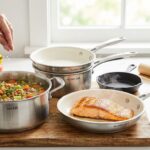
A light-colored interior for dark food, a dark interior for light food. This is the same idea as using a light cutting board for dark vegetables and a dark one for pale foods. A dark nonstick pan makes browned or dark food hard to distinguish, while a light stainless or light-colored ceramic interior shows it clearly. Eggs and pale foods can be easier to see against a dark surface. If you cook a lot of one kind of food, choose the interior that contrasts with it. Our nonstick vs. stainless steel guide covers how the two surfaces differ in everyday use.
A clear glass lid. If you have usable vision, a glass lid lets you check food without lifting the lid into the steam. If you rely on touch, glass has no advantage, so choose a lid on its handle and fit instead.
A pot with a visible, high-contrast handle. A handle that stands out from the stovetop and counter is easier to locate quickly.
👉 Browse light-interior stainless steel pans
For Blind Cooks and Touch-Based Cooking: Make the Pot Easy to Find and Control
A long, single handle that doubles as an orientation anchor. If the handle always points the same direction, it tells you where the pan is and where its edge is, so you can find it with a hand or a utensil. Handles that stay cool matter more when you find the pot by touch.
Tall, straight sides. You can feel the rim and judge the depth with a spoon or utensil, and deeper sides keep liquid further from the edge. Filling no more than about two-thirds reduces the chance of spills. The same logic appears in our hand tremors guide, where depth is what keeps liquid in the pot.
A heavy, flat base. A pot that stays where you set it is more predictable than a light one that shifts when you stir. A non-slip mat under a pot on the counter helps too, and the Guide Dogs Australia page below mentions them for this reason.
A well-fitting lid with a large knob. It’s easy to find by feel and to lift without touching hot metal. Lids that fit the pot snugly also hold in splatter.
A pour spout or a ladle instead of tilting. Scooping with a ladle is often more controlled than tipping a full pot.
👉 Browse saucepans with long handles and lids
Which Stove Works Best With Which Pot?
There is no single best answer, and the choice is personal. A few facts help you decide:
Gas gives you a flame you can sense by sound and warmth, but the flame itself is open. Electric has no flame but stays hot after you turn it off, so it’s easy to touch by mistake. Induction heats the pot directly and has no flame, but only works with magnetic cookware, so check your pans first. Our induction cooktop cookware guide explains how to test them. Whichever you use, a flat-bottomed pot with a stable base works best, and it’s worth confirming your stove’s controls are easy to use by touch.
Habits That Make Any Pot Safer
Keep handles in a consistent position. Turning them the same way each time builds a reliable map of the stovetop.
Avoid reaching over hot burners. Use long-handled utensils, and place the pot on a front burner when you can.
Use a talking or probe thermometer to check doneness instead of looking, so you don’t have to judge by appearance.
Slide, don’t lift, where possible. Moving a pot along the counter is steadier than carrying it. For more on that approach, see our cookware for wheelchair users guide, which covers sliding and full-pot weight.
What to Avoid
Dark interiors for dark food, if you rely on seeing the food. The pan hides what you’re trying to check.
Very light, thin pots. They shift easily and are less predictable.
Small, hard-to-find handles. A handle you can’t locate quickly makes every move riskier.
Wide, shallow pans for liquids. They give liquid very little room before it spills.
If you’re also cooking with only one hand, our one-handed cooking guide covers what changes with handle and weight choices.
Frequently Asked Questions
What is the best cookware for low vision? A pan with an interior color that contrasts with your usual food, a long and easy-to-find handle, tall sides and a stable, flat base is generally the easiest to use safely. A clear glass lid helps if you have usable vision.
Is a dark or light pan better for low vision? It depends on the food. A light interior shows dark or browned food clearly, and a dark interior can make pale food easier to see. Choose the one that contrasts with what you cook most.
Which handle is best for blind cooks? A long, single handle that stays cool and always points the same direction is easiest to locate and use as a reference point for where the pot sits.
Is induction safe for people with low vision? Induction has no open flame and heats only magnetic cookware, which some people prefer. The surface can still be warm from the pot, so it needs the same care as any stove.
Choosing cookware for low vision is mostly about contrast, a handle you can always find, and a pot that stays put. For more adaptive kitchen ideas beyond cookware, Guide Dogs Australia’s cooking techniques for people with blindness or low vision is a solid, non-commercial resource worth reading. Everyone’s vision and needs are different, so an occupational therapist or low vision specialist can give personalized advice.
Disclosure: This post may contain affiliate links. If you make a purchase through one of our links, we may earn a small commission at no extra cost to you.